Our financial picture
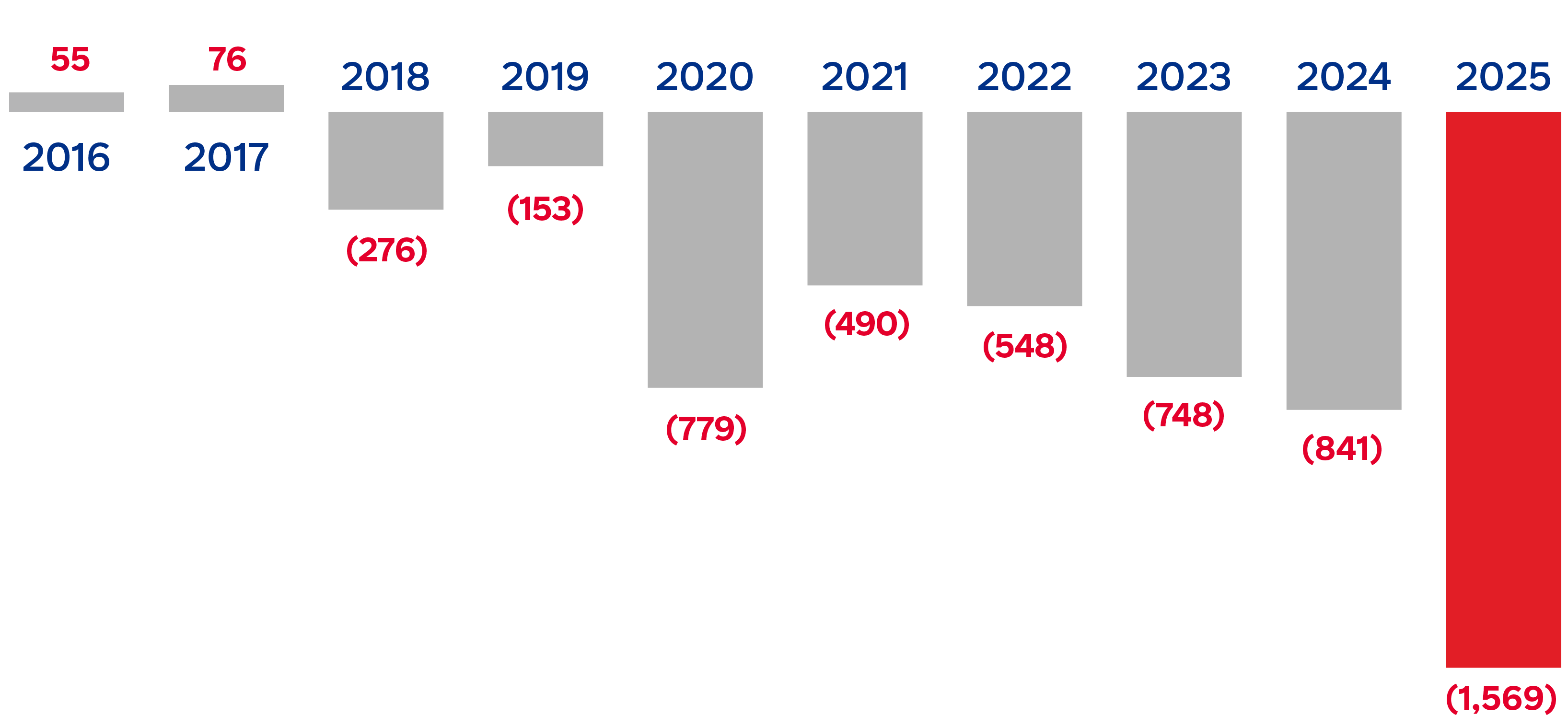
Canada Post’s financial situation deteriorated significantly in 2025 as labour uncertainty weighed on the business, and decades-old rules and frameworks continued to impede the company’s evolution and ability to compete. The Corporation posted a 2025 loss before tax of $1.57 billion – expanding by $728 million compared to a loss before tax of $841 million in 2024. It was the company’s largest loss on record.
The Corporation’s serious financial situation underscores the imperative to transform and the urgency of its proposed reforms. Building on new tentative agreements with the Canadian Union of Postal Workers (CUPW), and the federal government lifting long-standing policy and regulatory restrictions, Canada Post needs to transform to return to financial sustainability and build a modern postal service for Canadians.
Transparency and global standards in our financial reporting
Canada Post prepares its financial statements in accordance with IFRS Accounting Standards as issued by the International Accounting Standards Board – the global standard for financial reporting. Our statements are jointly audited by independent third parties, including one of the Big Four accounting firms and the Office of the Auditor General of Canada. Auditors receive full, unrestricted access to our data. They are required to demonstrate independence and professional conduct and follow other requirements of Canadian generally accepted auditing standards.
Losses driven by rapid changes in the postal landscape
Canada Post recorded cumulative losses before tax of $5.4 billion from 2018 to 2025. These losses have been driven by rapid changes in the postal and parcel delivery sectors, along with legacy restrictions that have impeded the company’s modernization and competitiveness.
The Corporation’s 2025 loss from operations was $1.62 billion, widening by $334 million compared to a loss from operations of $1.29 billion in 2024. Since 2018, cumulative losses from operations amount to more than $6.1 billion. For comparison periods, the loss from operations excludes income received from Canada Post’s divestitures of SCI Group Inc. and Innovapost Inc. in 2024.
Canada Post segment profit (loss) before tax
(in millions of dollars)
Labour uncertainty weighed heavily on 2025 results
Total revenue declined $315 million, or 4.7 per cent, compared to 2024. Strike activity and labour uncertainty weighed heavily on the 2025 results for Parcels and Direct Marketing, while Transaction Mail benefitted from a postage rate increase and temporary volume bump. Below are the 2025 lines of business results compared to the prior year.
- Parcels revenue and volumes fell sharply, by 30.1 per cent and 32.6 per cent, respectively. The drop was mainly due to the lasting impacts of the 2024 labour disruption and continued labour uncertainty through 2025, which pushed customers to other delivery providers. Decades-old rules and frameworks also limited the company’s ability to compete. Given the impact on customers, the lost parcel volumes will be challenging to win back – emphasizing how critical it is for Canada Post to modernize in a competitive market.
- Transaction Mail revenue and volumes rose by 26.2 per cent and 2.4 per cent, respectively. The line of business benefitted from a postage rate increase in January 2025 as well as a volume increase related to election mailings and a temporary surge following the national strike in the fourth quarter of 2024. Despite the increase in volumes, the line of business will continue to erode as fewer Canadians rely on the service.
- Direct Marketing revenue and volumes declined by 4.5 per cent and 9.8 per cent, respectively. Revenue fell due to labour uncertainty and labour disruptions, including a ban on the delivery of Canada Post Neighbourhood Mail™ items in the second half of 2025.
Repayable funding from the Government of Canada
To prevent insolvency and ensure Canada Post could continue operating, in early 2025 the Government of Canada announced funding of up to $1.034 billion for the Corporation through the government’s 2025-26 fiscal year. The cash injections were used to cover operating expenses, which ensured continuity of postal services and stability for the workers who depend on their pay and benefits.
Canada Post started receiving these government cash injections in the third quarter of 2025. While the $1.034 billion was intended to carry the company through the government’s fiscal year ending March 31, 2026, the funding was insufficient due to the impacts of the prolonged labour uncertainty. In early 2026, the government approved up to $1.008 billion in additional repayable funding.
Transformation necessary to move away from government funding
Canada Post’s proposed transformation plan aims to position the Corporation for financial self-sustainability in the long term, incorporating several initiatives including revenue growth and measures to increase operational efficiencies.
As Canada Post improves its profitability and gets back on a path to financial self-sustainability, it projects a need for further government funding in the interim to enable transformation and sustain operations. Until the multi-year transformation and financial benefits can be realized, supplementary amounts will be requested, as required, to ensure the Corporation remains solvent.
Financial pressures of the Great Mail Decline
The ongoing, steady decline of letter mail, combined with the country’s growing number of delivery addresses, is one of the key drivers of the Corporation’s financial pressures. For more than a century, letter mail was the main source of revenue for the postal service. In 2006, letter mail volumes hit a historic high when we delivered almost 5.5 billion letters to Canadians.
Letter mail volumes have declined from 5.5 billion pieces in 2006 to 2.0 billion in 2025


Since then, domestic letter mail volumes for the Transaction Mail line of business have plummeted by 62 per cent. Canadians can see this sharp decline in their mailboxes. In 2006, the average Canadian household received seven letters per week; in 2025, it was two per week.
As our mail revenue falls, the cost of delivering keeps rising. We deliver to more locations each year, with over 200,000 new addresses added annually. In our peak mail year of 2006, we delivered to 14.3 million addresses. In 2025, we delivered to more than 17.8 million – a 25-per-cent increase compared to 2006. In today’s economy, a postal service built for letters cannot sustainably deliver for Canadians.
In 2006, Canadian households received an average of seven letters per week – in 2025, it was two per week


Focusing on growth and the modern needs of Canadians
Canada Post’s transformation addresses the shift in how Canadians and businesses use the postal service today. With the Canadian ecommerce market projected to double over the next decade, we are refocusing our business on growth. Our proposed transformation aims to deliver a modern postal service designed for parcel delivery – one that meets the needs of Canadians and businesses today and into the future.
Implementing this critical and proposed transformation will strengthen the postal service, better support businesses and enable national commerce – while helping the Corporation meet its dual mandate of delivering for all Canadians in a way that’s financially self-sustainable.
Cost of operations
Canada Post’s cost of operations increased slightly in 2025, rising by $19 million, or 0.6 per cent, compared to the prior year. Despite labour cost savings from lower volumes, labour costs increased $212 million, or 6.1 per cent, due to wage increases and an inefficient labour structure. Other operating costs fell by $175 million, or 7.5 per cent, compared to 2024, as falling parcel volumes led to lower expenditures such as transportation costs. Non-capital investment costs declined as the company continued to refocus its strategic investment priorities.
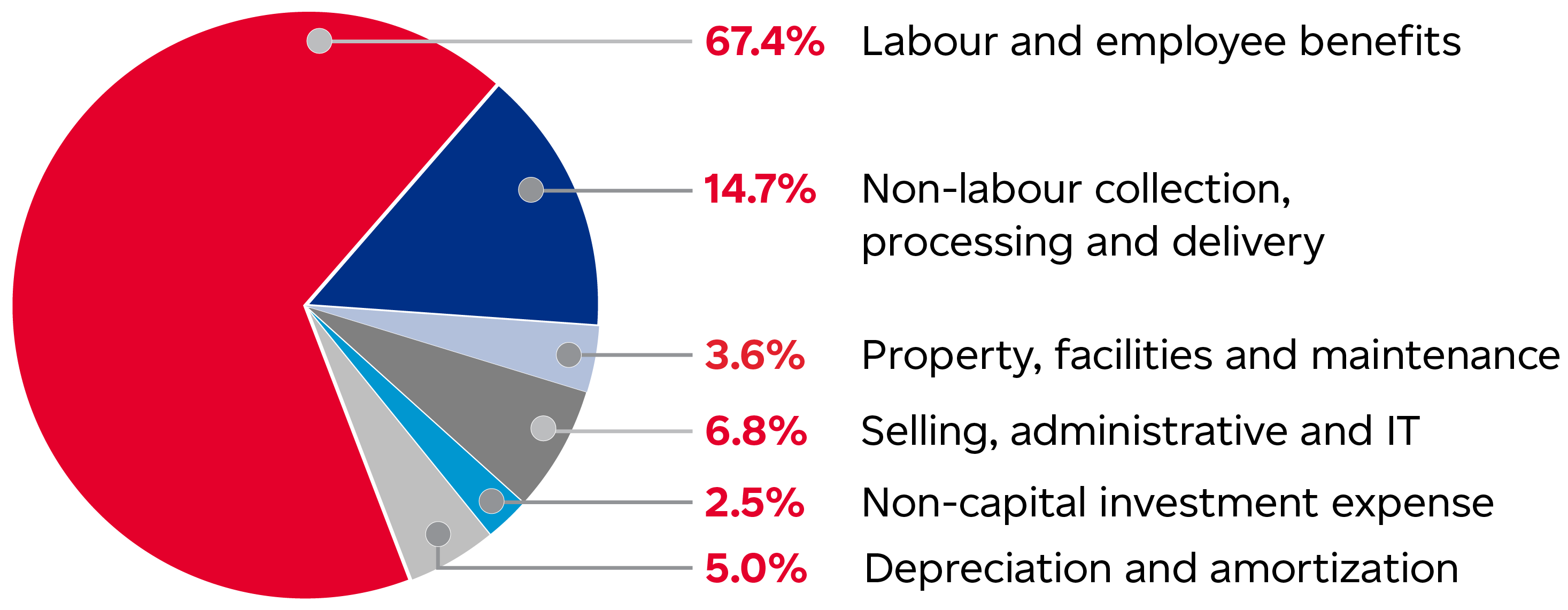
Breakdown of operating expenses – 2025
The Corporation continued to look for efficiencies and to control costs without impacting service. This included reducing management headcount by 10 per cent in 2025, a freeze on external hiring, and cutting back spending in areas such as travel, consulting, contracted services and non-essential investments.
Our business is very labour-intensive, with labour and employee benefit costs comprising 67.4 per cent of the total cost of operations in 2025. Long-standing restrictions on the business – through collective agreements and legacy policy and regulatory frameworks – impact the company’s ability to transform and effectively manage costs related to an inefficient, labour-intensive operating model.
Improving competitiveness and enabling more productivity in operations
The Corporation’s tentative agreements with CUPW, if ratified, will support the company’s revenue and profitability. The tentative agreements provide more flexibility to compete on price, quality and performance, while driving the company’s ability to rebuild business with customers. They will also enable greater efficiency in operations, with more staffing flexibility using part-time roles, a reduction in overtime and increased labour cost productivity.
Building on the Government of Canada’s decision to lift policy and regulatory restrictions, the company’s proposed transformation measures will also increase efficiencies and help control operational costs. Initiatives such as converting remaining door delivery to centralized delivery (e.g., community mailboxes), adjusting letter mail service standards, continuous improvement and resizing our workforce through attrition will contribute additional savings (see Aligning our network with a modern Canada).